Join our Mission - Donate

A community's out cry for justice
Refugees organize a statewide protest to highlight inhumane condition in Bavarian camps
5/8/20243 min read
August 15, 2019
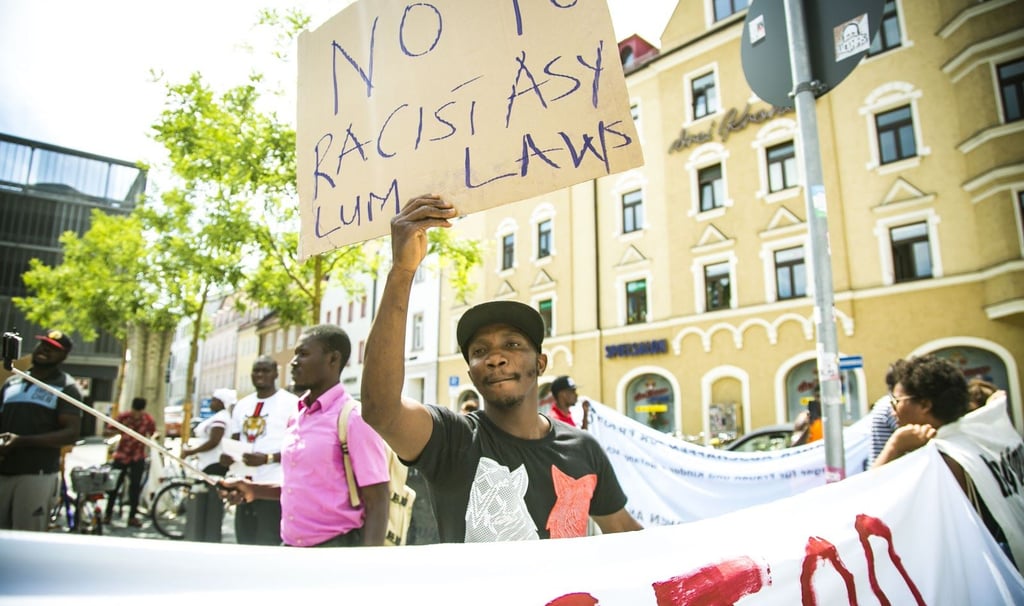
Nigerians and others in support of refugees organized protests around the state to emerge from the shadows of the countryside and raise awareness of the unfair treatment by the local government and the inhumane conditions they face in the ANKER centers.
There is a definite speculation as to why many Nigerians are sent to Bavaria. Some believe that it is due to their rigorous laws, and some simply say that it is a reflection of Germany’s internal system that groups people from similar countries within the same camps. Prince, a resident at the Furstenfeldbruck ANKER center, said that in an interview with the government regarding his asylum application, he was told by a caseworker, after sharing his personal story, that his story was “just like the rest of them.”
This statement reflects a huge belief that many Nigerians are arriving solely as economic migrants, which gives the German government more reason to deny applicants for asylum approval. On the contrary, various reports on the cause for why many flee the streets and villages of Nigeria reflect underreported gang violence within communities, the fear of Boko Haram, and the threat of violent Fulani herdsmen. By concentrating on four camps in Bavaria, this report aimed to explore the reasons behind the disproportionately large number of Nigerian asylum seekers in Germany relative to their low approval rate. After several interviews with individuals ranging from young mothers, politicians, young fathers, and elders, the main impediment that impacted this group was the Dublin Law.
The law, now in its third version since 2013, was first implemented in 2013 to scale the uncontrolled arrival of migrants and asylum seekers that had put a strain on the European Asylum System as a whole. The law essentially states that "whichever country you first seek asylum is responsible for your case.” For many Nigerians, their journey begins in Libya, where many of them are beaten, worked as slaves, or are captured for money. By paying their way through dark circumstances, they then move on to Italy, where their journey for security in Europe begins. For a large number of Nigerian women, Italy represents a place destined for prostitution, and for the men, an idle playground of no work. Germany’s open door policy, a few years ago, caused many of them to migrate to the country, hoping to experience the sweet taste of freedom that many other refugees experienced just a few years back. The country’s refugee policies have tightened overall, but this group in particular believes that they are a target for discrimination.
“When you see Nigerians in the news, all you see is “scammer this”—”scammer that,” and they see us as rowdy people; they don’t trust us; therefore, they don’t want us here,” says Chinedu, a young resident at the Furstenfeldbruck camp.
A “recent report” highlighted that BAMF (Federal Office for Migration and Refugees) agency found that two of their centers significantly deviated from the normal asylum application procedures, affecting two nationalities—mostly Nigerians and Eritreans. The report added that these two offices are currently under investigation, but did not say where they were located.
Hashem, a broadcast journalist from Yemen who was forced to flee and found himself at the ANKER center alongside Sandra said, “ I have only been here for a short time, but many of them have been here for 2 and some 3 years. When I had my interview for my asylum application, they just asked me where I was from and after that... that was it. My process was not long at all, but a lot of them seem to go through so much more.”
Solomon, a red-haired, freckled Nigerian refugee, stands out among the others and is careful where he travels because of the harsh and rigorous police activity within the camp and its surrounding areas. “They know me because of my hair, so I am very careful around here because the security will call the police on you for any little thing, especially on the Nigerian men.”
Although they march by day, at night in small towns throughout Bavaria, ANKER centers remain filled with a large number of Nigerian asylum seekers sitting, waiting, and hoping for answers.
“I would rather die than to sit here and waste my life; my wife is having a baby soon, and my baby must live a different life,” says Solomon.
As the refugee crisis continues to flow in and out of the news cycle, this particular group of migrants continues to battle between their fantasy of the empathic country they saw as Germany and the present-day reality of their day-to-day life living in the ANKER centers, as the years pass them by.
(The full names of subjects within this article were withheld for confidential and safety reasons.)
Published in collaboration with the Pulitzer Center on Crisis Reporting
A Nigerian asylum seeker holds up a sign during a protest of Anker centers in Bavaria, Germany. Image by Angelica Ekeke. Germany, 2019.
A Nigerian asylum seeker holds up a sign during a protest of Anker centers in Bavaria, Germany. Image by Angelica Ekeke. Germany, 2019.